

With the possible exception of Below Deck, nothing unites Americans more in 2026 than their opposition to having data centers built in their backyards. According to a Gallup poll conducted in March, 70% of Americans don’t want AI data centers built near where they live, and 48% identify as being strongly opposed.
Across the country, the political ramifications of this animosity are far from abstract: last month, the President of the Utah state Senate lost his primary after he supported a data center project near the Great Salt Lake; a St. Louis suburb voted out half of its city council after they supported a data center; Warrenton, Virginia did the same.
In Montana, developers are planning at least two major projects: Quantica in Broadview and Sabey, at an undetermined location. (The developer Krambu had proposed a third project, in Bonner, but withdrew its application yesterday.)
Both ongoing projects face local opposition, in large part due to their extraordinary anticipated energy and water consumption, as well as noise concerns. The Bonner project faced regulatory hurdles specific to Missoula County; residents of Butte-Silver Bow and Yellowstone Counties are currently gathering signatures to get measures on local ballots that would hamper data center construction.
Adding to the contention, NorthWestern Energy proposed a new rate structure for data centers this spring, setting off a related debate over the cost allocation of these new facilities.
To unpack the fraught state of affairs, I spoke to Anne Hedges, the Executive Director of the Montana Environmental Information Center (MEIC). Anne has worked for the organization for over thirty years; nothing, she told me, has galvanized Montanans like the potential incursion of AI data centers.
It goes without saying that Anne brings an environmentalist perspective to the conversation. But she’s far from an absolutist when it comes to her opposition to AI and data centers. Read on as we discuss her take on “tech bro” Gov. Gianforte and his industry-heavy Energy Task Force, the bipartisan hostility she has encountered across the state and how she sees the data center issue playing out in next year’s legislative session, including bills that MEIC is already drafting.
Reader’s note: This is the final BSCH transmission before Lacy and I welcome our baby girl into the world later this month — you might not hear from me for a minute! That being said, I hope to be back at the Chat House helm sooner than later, as I find myself stumbling around the house in a sleep-deprived state, yearning for someone to validate my fragile ego.
This interview has been lightly edited for length and clarity.
Max: Of these data center projects, which feels closest to becoming reality?
Anne Hedges: That’s really hard. There’s just such a race in the data center development world to get something built as quickly as possible and lease it out to whomever wants it and make a ton of money before the whole house of cards comes tumbling down.
The one that is most threatening is the Quantica facility, just because of its sheer size. It is enormous: almost nine gigawatts. So 9,000 megawatts. It’s insanity.
They’ve talked to DEQ about 1,700 megawatts worth of gas plants. That is larger than Colstrip is today. That would be the largest power facility in the state.
It is enormous. And that requires infrastructure. It requires methane gas.
And aside from its sheer scale, it’s in a really dry area of the state. And they have been completely opaque about their cooling system and how much water they’re going to need and where they’re going to get it.
Can you explain how Missoula County is an exception in terms of its existing regulations?
Missoula is unique. Missoula had a crypto operation that was really disruptive to the community quite a few years ago now. And so they put these regulations in place. What Missoula has that nobody else has is transparency. It has the public right to know.
It has a public right to participate. It has noise restrictions. It has lighting restrictions. It has clean energy requirements. And not just any old clean energy, but new clean energy that has to be added into the system. They have the ability to look at the water system and make sure that you’re not impairing water for water bodies or for senior water right holders. It is truly a wonderful setup.1
I really applaud their commissioners for wanting to make sure that those provisions of that ordinance are applicable throughout the county and not just in very specific locations. Because we’ve seen people up to a mile away [from data centers] that are complaining about the noise. They can’t sleep. They can’t open their windows. It’s the same complaints that Bonner people had back in the crypto days.
It’s something that I think every county in the state deserves; that type of review and to have the public participate. No other county has that. And that to me is remarkable considering the threat that these counties face.
That reminds me of the xAI facility in Memphis — a lawsuit was filed there because of the pollution from all of the gas turbines. With that in mind, do you see the Montana State Constitution’s language around the right to a clean and healthy environment being an effective backstop against that level of pollution?
It’s insufficient because it’s after the fact. The Constitution only comes into play after a government entity or a private developer has made a bad decision. And it’s very difficult to stop them from moving forward with that bad decision while it plays out in court. And courts are notoriously slow at making decisions.
We need a state DEQ that does its job instead of kowtowing to developers. We need a DNRC that is on top of the water rights issue. And we need a Public Service Commission and a legislature who take these energy issues seriously and protect the people of this state from this new industry that could very easily go belly up in just a few years.
I’m glad you brought up the PSC. For a general audience reader, how do you explain how Northwestern Energy and the PSC fit into this equation?
Since 2009, [NorthWestern Energy customers in Montana have seen their] electricity rates increase 99%. They have gone up over 40% since the middle of 2022. That is astronomical and people cannot afford their electricity bills.
The reason that has happened is because the Public Service Commission has allowed NorthWestern to do that. They haven’t done their job. Period. End of sentence. They have not protected the people of this state.
And that will get worse unless the Public Service Commission develops a set of rules to protect existing customers from data centers. That’s all we’re talking about: is the PSC going to do its job? Or will it develop a set of rules that enriches NorthWestern shareholders and their CEO? Their CEO is very handsomely paid.
If a data center facility is covering their costs, why would they be passed on to the consumer in Montana?
Because if they are getting service from NorthWestern Energy, you are helping to pay for their transmission, for their distribution lines, perhaps for their generation, their power plants, which cost hundreds of millions of dollars.
We have to make sure that we are not sharing in those costs.
So right now, what NorthWestern wants to do is bring data centers into the fold and share those costs across all customer classes, residential customers, large industrial customers, the data centers. But if we just socialize the costs of those data centers, which is NorthWestern’s plan, then we will be paying higher bills.
So the set of rules will determine how they come online, how they come into the system. It’s really wonky, but there’s so many things that commissions like the PSC can do to guarantee that data centers pay their fair share. And really importantly, if they leave the system early, we are not stuck paying for the cost of adding them to the system when they’re gone.
What’s your take on the governor’s Energy Task Force?
The governor, he’s showing his true colors. He is a CEO of a corporation, and that’s how he is behaving.
But yet, in government, he is just one of three branches of government. He should be representing the people of the state. Instead, he’s representing his buddies in the data center world.
And so his entire framework is to try to give gifts to the data center industry on the backs of the people of the state. His entire framework is: how do we get data centers online faster, regardless of the impact they have on the system.
So they’re not talking about the Constitution. They’re not talking about energy sources. They are talking about gas all the time. They are all about coal. They love nuclear. These guys love the most expensive forms of energy available today.
That’s what they want. And the way to do that for them is just to socialize the costs onto the rest of us.
And there’s not a consumer advocate on that task force. There’s not a renewable energy developer on that task force. It’s simply about data centers.2
What he’s forgotten is that when he’s trying to get a bill through the legislature [in 2027], that the people of this state don’t like data centers. And there’s going to be a dogfight on his hands that he really, as a CEO, doesn’t anticipate because he’s really arrogant in the way he governs.
OK, I want to come back to nuclear later. But in the meantime, I genuinely don’t understand why they have this task force at all.
Politicians love to say they’re doing something.
And I will say he had the housing task force and it did come up with some decent recommendations. It was a very, very different set of people who were more focused on finding a solution to a really big problem in this state. And so I think that that worked. And he’s like, well, why don’t we do it for data centers?
He’s just doing what the governor does. He’s a tech bro. That’s all he is. He’s a tech bro. And he happens to be a multi-millionaire tech bro.
He just doesn’t think about the little guy. He doesn’t think about 99% increases in electric utility bills for homeowners. That doesn’t matter to him.
He’s probably never paid his own utility bill. He doesn’t care.
The image of Greg Gianforte as a bro is one I hadn’t considered, but it’s going to live rent-free in my mind for quite some time. Switching gears, from your vantage point, do you see anti-data center sentiment as being synonymous with anti A.I. sentiment writ large?
There’s a lot of overlap. I think that [being] anti-AI is a very conservative position. Actually, I think it’s across the board. Conservatives really are concerned about AI. And data center concerns are more focused on the local community.
I am not an anti-data center person across the board. I’m not an anti-AI person across the board. I think AI is dangerous. I think it really impinges on our privacy. I think that these guys are going fast and breaking things and nobody is paying attention to the consequences. We absolutely need rules for AI.
We’ve had data centers for decades. We’ve just never had them at this scale. And I feel like AI is somewhat, it’s not going away, but this current situation is a flash in the pan. It’s like the dot com bubble; everyone wants to get to the finish line first. Nobody has figured out how to monetize it yet.
And so the people who get there first may be able to monetize it, but there’s going to be saturation because there’s just not that much use case for it.
Can you tell me a little bit more about why you associate anti-AI sentiment more with conservative folks? Speaking anecdotally, I’ve had the opposite experience.
I see people really concerned about privacy, concerned about somebody looking over their shoulder, watching what they’re doing, stealing their information. I think Ron DeSantis is the leading person opposed to AI.
But I’ve talked to a lot of conservatives around the state on this issue, and I’ve been very pleasantly surprised by their reactions. We’ve held over a dozen events across the state, and I don’t think there’s been an event where somebody didn’t say, why do we need AI?
There’s a lot of plaid shirts, I guess I should say, in the audience when we do these events. We’re not just going to Missoula or Bozeman. We’re trying to be a little bit more focused on the rural areas where data centers have been proposed or likely to be proposed.
And I’m not hearing anybody say that AI is great. I’ve heard Republican legislators say that they don’t mind data centers, but that AI is a problem. And that to me is heartening because that’s a place to start.
AI needs to be solved at this legislative level. Congress needs to get off its ass and do its job. And it’s not.
Something I want to circle back on: if I understood correctly, you don’t see a lot of use cases for AI in general?
These guys aren’t making money because nobody needs their product. They always point to the medical industry. They point to national security.
Well, tell me how much of this AI and data center development is really national security. They don’t know because most of these guys don’t know who the leesee of their facilities will be. They banter these words around like they matter and they can’t prove that it’s a federal government that’s going to come in and use it for national security.
I find [AI] very unhelpful. Most of the time they’re not selling anything yet. And Wall Street is worried about that. They’re pouring more money into this than in the history of the United States.
This is an arms race without a buyer.
For what it’s worth, I’m a bit more optimistic about AI. Especially being a visually impaired person, I’m a pretty staunch advocate for autonomous vehicles, which, granted, don't rely on data centers in quite the same way.
That is going to be useful. And we do find uses for AI, but not at a growth rate and not at the level that these guys are planning to grow in the next five years. And I’m in favor of all of the technologies that can help people with a disability. It’s amazing stuff.
My position is, we’re gonna have some data centers. We’re gonna need them because there is a use case for some AI. But we need sideboards on AI. We need sideboards on the development of data centers. And we should let some of these guys go forward. But they have to go forward by a set of rules that protects all of the natural resources, the public health, the energy, the water, the communities. And the bottom line is they can. They can, they don’t want to.
There’s just so much money involved that it clouds people’s judgment.
I recognize we’re looking into the crystal ball a little bit here, but how do you see this playing out in the ‘27 Legislature?
Well, the primaries are over. And in this state, primaries are where decisions get made on who’s coming to the legislature. We live in a new world of primary politics. And so I don’t think anything’s going to happen between now and the legislature that’s going to radically change anything as far as the composition of people who are going to be there.
I do think that next session, you’re going to have legislators who are really struggling to figure out their path forward. Because people are going to come forward with bills to fix all of the problems that we face because of data centers. And it’s not going to be one big omnibus bill that’s going to take care of everything. And that’s all we’re going to be debating.
There’s going to be probably half a dozen bills on water, half a dozen bills on community needs, half a dozen bills on energy. There’s just going to be a lot of different bills that legislators are going to have to figure out.
And if they go home without doing anything, they will lose their seat. I just don’t believe that any of them can say, “I don’t care, and I’m going to vote no on everything.” I don’t think that’s going to pass muster.
So I think there’s a real threat there for them in the next election cycle.
I am optimistic that we’re going to see some rational thinkers this session, that people are going to listen to their constituents. I think we are going to see a lot of bipartisanship in a way that we really don’t see in most other issues.
The Solutions Caucus, they’re in NorthWestern’s pocket. They’ve always done whatever NorthWestern wants. I don’t see a lot of help from the Solutions Caucus people, but I do see a lot of concerns from the far right. I see a lot of concerns from the Democrats. And so I think we’re going to see very interesting coalitions forming this session.
Do you see this issue putting some wind in the Democrats’ sails?
It depends. I mean, Democrats have to stop being their own worst enemy.
I think their platform is a great start. I was really surprised to see that they supported a two-year moratorium. But it can’t get through the legislature, and I don’t think it will be signed by the governor.
So we better have something else in our back pocket about these data centers and the programs we need to develop to protect existing customers.
And the problem is labor. You know, I love those labor guys, and I want every data center to be a union outfit. Our union guys, they’re great electricians, they’re great plumbers, they go through an amazing amount of training, and they are top-notch. And people deserve a good wage for that kind of work. However, you can’t ignore all the other harm the data centers cause in your quest to get good trade union jobs.
So you need a balance. And I don’t know if Democrats are gonna be able to balance that in the heat of the moment. I see Democrats all the time siding with labor over environmentalists in the Capitol, because labor just has more clout in their minds.
Not all of them, of course. I want to be clear. There’s some Democrats out there who really know how to balance those two, because they can be balanced. It is not an either/or. And anyone who says you’re either with labor or you’re against labor, they’re wrong.
And so Democrats are gonna face some struggles because unions want jobs. That’s their sole purpose, to create more union jobs and create electricians that are safe.
When you say Democrats are their own worst enemy, as a pretty politically moderate person myself, I have my own feelings about what that means. Were you referring to something beyond this tension between labor and environmental issues?
It’s just so ubiquitous (laughs). But for the purpose of the data center conversation, I’ll rely on power plant issues and what laws have passed with Democrats’ support that weaken our environmental protections, that weaken the public’s right to participate, and all in the name of jobs.
And that to me is, they’re cutting off their nose to spite their face. I think that everybody should be standing up for our constitutional right to know, to participate, and to protect our natural resources that really feed our economy and our health. It’s not that hard to get behind.
But when you have Democrats voting in favor of weakening mercury and air toxics, or when you, from power plants, when you have Democrats voting in favor of weakening NEPA, which is the primary mechanism for the public’s right to know and participate, then they’re not doing their jobs. They’re not doing what their platform requires of them. So yeah, they can be better, and they should, and some do. And some do, and they get reelected.
I’ve got a hunch, but I’m curious what you think about Ezra Klein’s abundance argument.
I’m not a big fan of Ezra Klein.
I didn’t want to assume.
I find his abundance thing really simplistic. I think it’s a lovely sentiment, but it is devoid of reality.
What’s the best way to go about setting up sufficient regulations for data centers in Montana?
It’s about timing. When I think about what we need to do, I think about the things that are being done now before the session even starts. And then, the session doesn’t end until April, and we can’t wait till April. We are at risk if we wait till April to develop rules.
And then, unless the bill specifies, those bills don’t go into effect. And then, if there’s rulemaking associated with it, then a lot of times legislators wanna delay the effective date of the bill until rulemaking is complete, we don’t have that kind of time.
So the local ordinances that people are pushing, those are really, really important for those local areas who are facing data centers immediately. The Missoula review process, that is really important.
Missoula County is sticking to its guns and it’s really heartening to see.
The Public Service Commission will decide before the legislature meets next year what set of rules will govern data centers, and whether our electric bills are going to increase or decrease as data centers come online.
That to me is one of the very most important things that people should be paying attention to. And if the PSC gets it wrong, we will be in the Capitol trying to fix their errors. But I don’t wanna wait.
Our tech bro governor is super pro-data centers. And if you want to overcome that, you’ve got to have a supermajority of people who are willing to override a gubernatorial veto.
So all legislators matter in that case because we need a lot of legislators to be willing to buck their governor. So I’m trying to parse this out by what are the most immediate ways to address this problem and plan for the long-term.
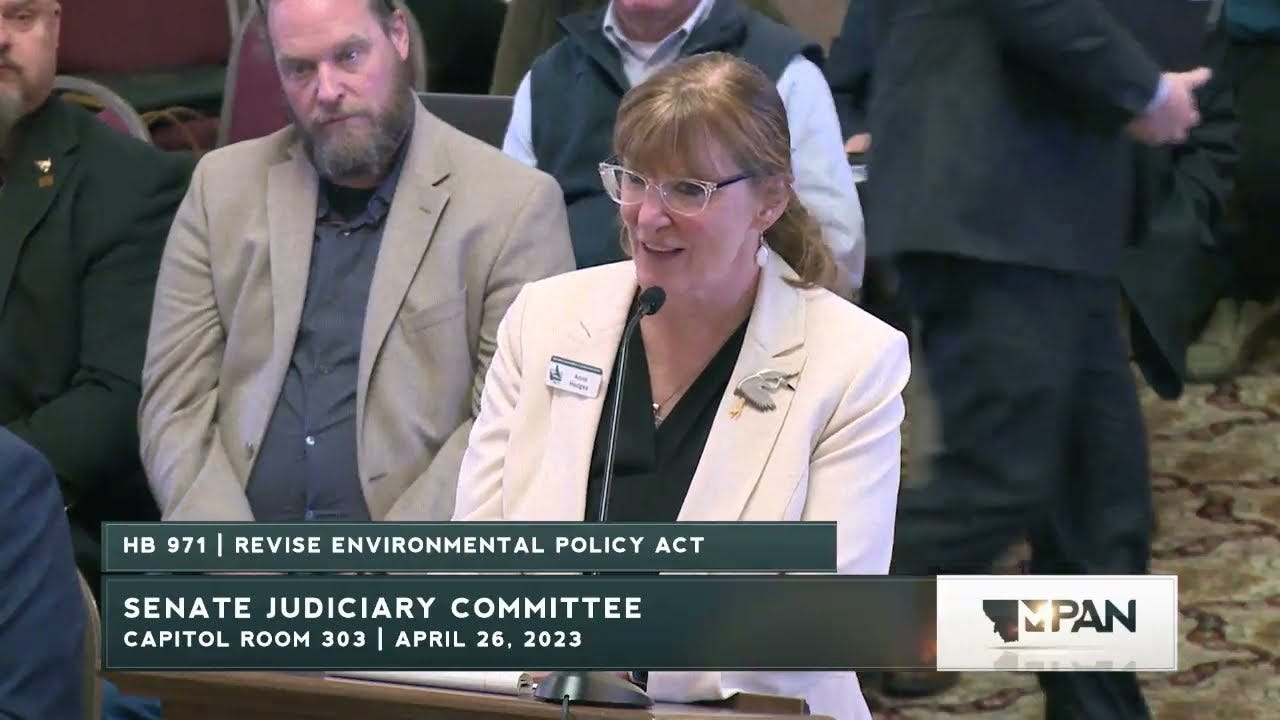
Is a good chunk of what MEIC might end up doing effectively running a pressure campaign?
It’s what we always do, but we’ve never had such an abundance of individuals on both sides of the political aisle who are demanding that they be protected.
So yes, and we’re also a policy shop. And so we are working on bills right now. We have drafts of half a dozen bills that we want introduced.
And we’ve worked with legislators already on another half a dozen bills.
Are there any specific bills you think would be helpful for a reader to be privy to?
I think that the set of rules for what the Public Service Commission needs to do in order to ensure that there is no shifting of costs between residential customers and data centers, that is gonna be a really important bill. That’s gonna be critical.
I don’t trust our PSC. They side with NorthWestern time and time again. So I don’t wanna just rely on them doing their job.
We’re gonna need the legislature to step in and develop some more.
We absolutely need a water bill. Idaho passed a bill to protect water resources. If Idaho can do this, with overwhelming support from both sides of the aisle, so can we.
And then there’s the community bill. And my goal is to have a bill that really does provide a framework for every county to do what Missoula is doing, and protect those people who are gonna live near these data centers.
One last question for you: what is your take on nuclear power?
The Trump Administration is deregulating nuclear power at an unprecedented rate. It is unsafe. And my feeling before the Trump administration was why would we go with the most expensive form of power available to man today when we have cheaper alternatives available? We already are paying way too much in our utility bills.
And nuclear power will do nothing but drive up those costs.
It is alarming. And anyone who is pro-nuclear needs to pay attention to the deregulation that’s going on at the Nuclear Regulatory Commission and at the Department of Energy.
Maybe nuclear energy could have been safe in a normal circumstance. But we don’t live in normal times. We live in very abnormal times.
We need people to kick the tires on this new technology before we put it out in communities. And that is not happening.
So I’m not pro-nuke. I just think it’s a silly experiment that we don’t need to do because we have cheaper available technology today.
Anne, is there anything you’d like to add before we wrap up?
I just think we have a moment in time in which we can bring people across the state together, regardless of political affiliation, and to come up with some common-sense solutions [so Montanans can] maintain an affordable energy system, that they have the water resources they need to fish in the summer and to float in the summer, and to feed their crops.
And our communities deserve to be protected. People’s life savings are wrapped up in their property and their homes, and the safety of their family is paramount to them. We should make sure that they still have value in their homes, that they still have the right to live where they’re living, free from undue noise and vibration and disruption and flooding and runoff.
These power plants they wanna build at these facilities are phenomenally polluting, and people shouldn’t be breathing that air. That’s not right. And we don’t have an administration at the state or the federal level that’s gonna protect people adequately.
And we will do what we can to go to court when the state and the federal government fail, but that takes a long time. So we need protections upfront for communities across the board.
The Montana State Constitution guarantees the right to know and participate to all Montanans. In a follow-up email, Anne clarified that “Constitutional rights are only as good as their implementation and enforcement. While we have a constitutional right to know and participate, the law does not require state or local review prior to the development of a data center. Local governments have to have zoning in order for there to be a public review process, and most counties do not have much, if any, zoning.”
While the task force does not include any renewable energy developers per se, it does include representatives of NextEra and NorthWestern Energy, which both have renewable generation in their portfolios.