
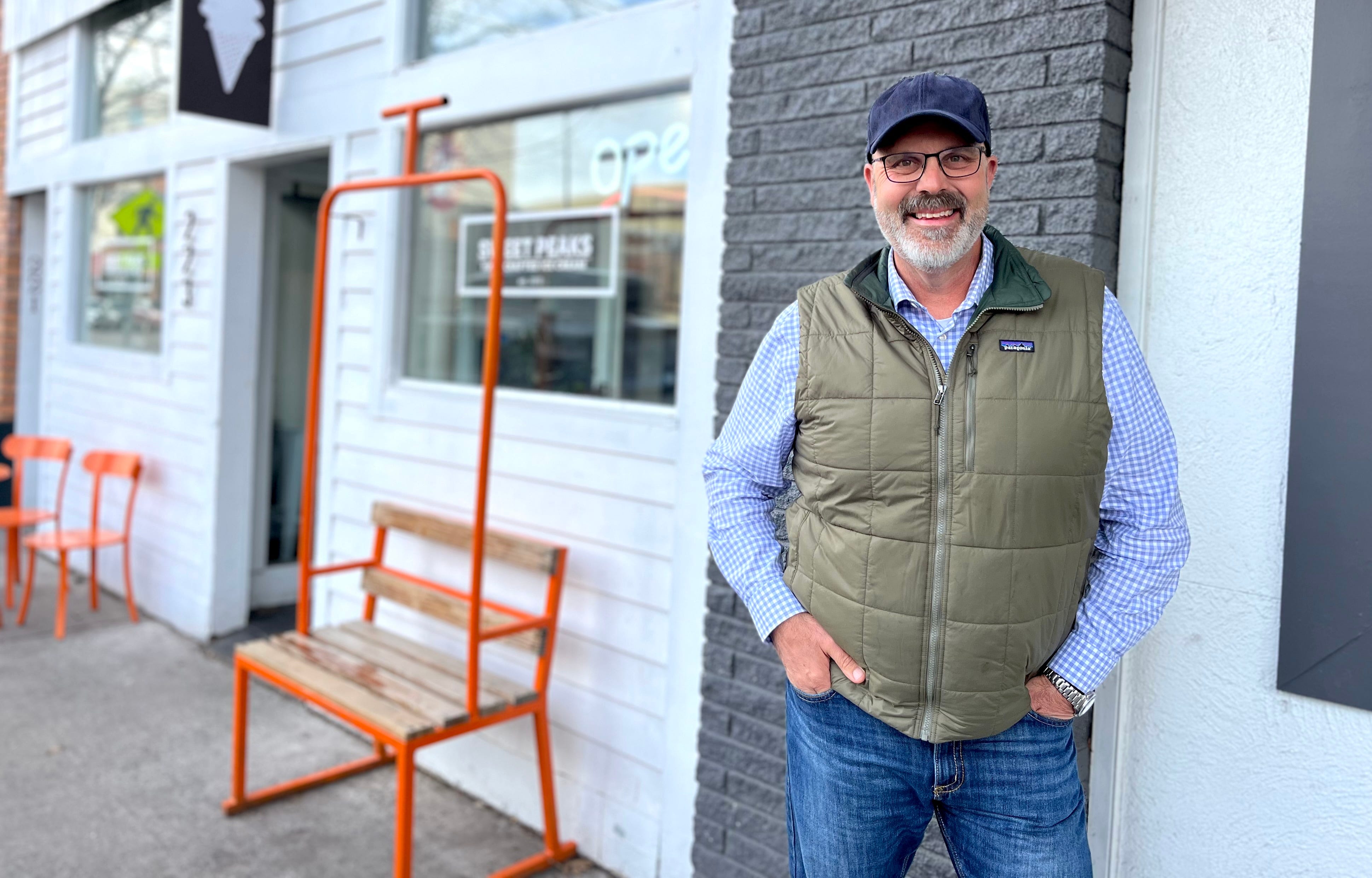
Two years after he ran for governor, Ryan Busse is back, and campaigning in a four-way Democratic primary for the Congressional seat being vacated by Ryan Zinke.
The tenor of Busse’s campaign seems, at least at face value, pretty similar to his last one — impassioned calls for progressive policies while lambasting and trolling the GOP. But even if Busse himself hasn’t changed much, the political dynamics of western Montana feel a bit less calcified than they did two years ago. Heck, if you’d told me in 2024 that a Democrat could become mayor of Kalispell in 2025 (albeit in a three-way race), I would’ve called bullshit.
No matter which candidates win their respective primaries, the race for MT-01 has the potential to be more competitive than either Busse’s run for governor or that year’s Zinke/Tranel matchup, due to headwinds the GOP is facing. Gas prices are up (as of this writing), and a majority of Americans aren’t onboard with the conflict in Iran. Statistically speaking, the party that controls the White House tends to lose seats in the midterms. Trump isn’t on the ballot. And none of the GOP contenders, with the debatable exception of Dr. Al Olszewski, possess much of Zinke’s affability. (That all being said, the Cook Political Report currently rates the race as “Likely R.”)
I recently sat down with Busse in Missoula to dig into his campaign priorities and why he sees this moment as being particularly politically malleable. Our conversation soon branched out, covering everything from his endorsement from Arizona Senator Ruben Gallego to the need to balance antagonism and positivity on the campaign trail. We also talked about GOP primary candidate and radio host (and Chat House alum) Aaron Flint, who Busse sees as the shoo-in candidate, as well as Jon Tester’s claim that the Democratic brand is “poison.”
This interview has been edited for length and clarity.
Max: It’s maybe not the cheeriest note to start on, but I was hoping you could take me back to the end of your 2024 campaign. When it was over, did you feel like you wanted to get back into politics right away? What was going on in your head?
Ryan Busse: Almost immediately, two things: One, I felt probably like a lot of people who are reading this — it was a dark time after that election day. Of course, the race I ran in, we lost, but it felt like the nation had just made a pretty drastic shift.
Sara and I and my boys—we’ve listened to Montana Public Radio every morning for, I don’t know, 25 years. Literally every morning. And starting the day after the election, nothing was on in the house: the radio wasn’t on, the news wasn’t on, and I think we went 30 or 40 days without listening or watching any news. It was just a little bit shocking and jarring.
At the same time, I almost immediately thought that there was going to be another big task at hand and that there was going to be a big negative reaction to what was about to happen. And so it wasn’t long after the election, even as shocked as we all felt, that I thought, “We got something here; we should probably think about what we do with it next.”
Why did you want to run in this race, specifically?
I think Democrats have been insufficiently focused on winning elections where they must be won. And I looked at this race and I thought that just demographically, it’s a race that Democrats can win. And in a midterm like 2026, it’s the kind of race we should win, right? And if we want to have a healthy democracy where we don’t just have blue seats on one coast and the other coast, but we have purple and blue districts spread throughout the country, this is an important one.
I looked at it like, this is the most winnable race in the state for Democrats. We deserve representation in D.C. I don’t feel like most Montanans have had representation in Washington, D.C. the last few years. I don’t think Zinke has represented most Montanans.
What do you mean by that?
I believe that Zinke and many in his party have decided that only a small sliver of Americans, or Montanans in this case, deserve representation. And for the most part, those tend to be wealthier, more powerful individuals. And all the folks who live here, work here, make the place go — the cops and mechanics and nurses — they don’t have lobbyists in the Capitol all the time. They don’t have fancy attorneys.
I look at this one sort of legislative achievement of the Republicans in the past few months, the “Big Beautiful Bill”—it’s difficult for me to say that because I don’t find it beautiful. But it’s very clear to me who has the influence there. If you’re a billionaire or Elon Musk and you got big tax breaks, you obviously had influence there. But everyday people on Medicaid? They didn’t seem to have any influence. People who need SNAP? They didn’t seem to have any influence. People who need ACA tax credits? They didn’t seem to have any influence. These are all things that impact the vast majority of folks who live and work here.
If that’s the case, if people really don’t feel represented, why can’t Democrats win more races in this state?
Yeah, good question. I think the truth is that in the Trump years, culture warring and the sort of divisive rhetoric and this angry fever that has been laid over all of us has been effective politically.
Now when I speak to voters, they’re freaked out because they’re worried about their healthcare expense going up, they can’t afford to live here. I mean, Sara and I were lucky enough to come to this state 31 years ago, and it was a place that gave me a chance, and it was a place you could make your way. We were lucky; it was just a timing thing. And now it feels like that’s changed. I have sensed a real dramatic shift in that the culture warring stuff just doesn’t come up when I’m talking to voters, even crossover and Republican voters now.
The lived experience of people is different and seemingly more dire now than it was two years ago, and I think that’s changed the political reality here.
Every campaign cycle I think about the famous James Carville line, you know, “It’s the economy, stupid” and how much weight it really carries. Do you feel like that argument carries weight this cycle?
I think it’s more than that. It is the economy…his statement is largely correct, right? Whether you can afford groceries or not is an existential thing. Whether you can pay rent or not is an existential thing.
But it’s also why it’s happened. President Trump laid tariffs all over everyone. It’s made groceries more expensive. In the Flathead where I live, it’s driven Canadian tourism into the tank. Zinke, Daines, Sheehy, Downing — they have only cheered it, supported it. And for what? We can do so much better than this. We really can.
I want to talk about the balance between addressing problems and offering solutions during the campaign. It feels to me that in your race, in virtually every race I’m following right now, it’s much more of the former than the latter.
Look, the truth is, for the next two years in Congress, it is going to be largely about stopping bad policies from progressing and reversing some of the damage that’s happened. That much is true. I think we also have to understand as Democrats we have to offer a bigger affirmative vision for things, not just that we want to stop and correct, but things that we want to accomplish.
Here’s a good example: I’m running hard on universal healthcare. I think we’re 50 years behind the curve as a country on universal healthcare. Even now I talk to a lot of Republicans and crossover voters, they don’t quite have a moniker for what they want the program to be called, but they’re done with whatever this insanity that we’re living under is, you know? We’re spending twice as much money as most industrialized countries, and we’re kicking people off coverage all the time. We have people living with 10 and 15 thousand dollar copays. It’s just craziness.
Yes, I’m criticizing the fact we haven’t instituted universal healthcare, but I’m fighting for it. And I think we should, as Democrats, be honest that much of the reason we don’t have it in this country is because some Democrats have been insufficiently courageous about fighting for it. Even though I think a lot of them know it has to happen, politically, they just haven’t led on it. And I don’t blame voters for being pissed about that. I mean, I’m pissed about it.
In March, that Tester memo leaked, saying that the Democratic brand is “poison.” How did that sit with you?
I know the memo of which you speak. If there are problems with the Democratic brand, and some voters feel that, then I feel it’s incumbent on me to not just whine about it or wring my hands about it, but to help change what the Democratic brand is.
I look around in groups of Democrats and I explain, there is no overarching “the party.” There’s us. There’s people. There’s candidates. There’s voters. We make up the party. And so if we want it to be something different and to have a different brand, then let’s run, or advocate, or knock doors, or whatever, in a different way. And I’m trying to be that.
I disagree…I believe a Democrat can win statewide, but we have to run as a Montana Democrat and we have to do things, not just say them. And I think we have to be courageous and unapologetic about criticizing national party messaging or policies that don’t match with voters in this district. I mean, I believe in the principles and values of the Democratic party, but there are sometimes the approaches of national Democrats that just don’t—man, they just don’t fly here, you know? And so being honest about that with voters is really important.
What’s an example of that for you?
Universal healthcare is one of them. We run around telling everybody there’s a healthcare crisis. I think most people know what needs to be done, and then we’re like, “Well, okay, let’s not really do it.” Well, no wonder voters find us disingenuous, right? Because we say the house is on fire and they’re like, “Well, we don’t want to get the bucket of water.”
I think of housing costs, too. Democrats run around talking about this big word of “affordability.” That’s just a big catch-all word. If we really are worried about all that stuff, then why aren’t we stepping on the gas of things like first-time homebuyer assistance and locking in low interest rates for homebuyers? And figuring out some sort of rental assistance program? Because most people—I mean, my son lives here in Missoula and he’s struggling to make rent. We talk about all these programs; well, let’s do something about them.
If you win the Democratic primary, which Republican would you prefer to run against in the general?
I really don’t have a preference. It seems to me that the GOP hierarchy has selected Flint as the person they think can and should be their candidate. They’ve put all their endorsements and a ton of money behind him. So I guess that’s who they’ve selected. They’ll duke it out in their primary and we’ll see what happens.
I remember maybe it was either right before or right after you and I spoke last, you went on Aaron’s show.
I did, yeah. I’ve been on there three times [during the gubernatorial campaign].
What were your takeaways from spending a decent chunk of time with him?
There isn’t a far-right or MAGA talking point or conspiracy or bad idea that he’s not embraced and propagated and cheered. I literally don’t think there’s a single one. And he has lived an existence on his radio program where he gets to control the literal physical space—who calls, what the talking points are, when they get cut off, what sort of pejoratives he yells, all of that. And perhaps that works as a distraction technique and an angering technique for the small slice of folks that are his listenership. But that’s not the district, and that’s not the way politics works — you don’t get to like tell people what to think, you don’t get to control the space, you don’t get to cut voters off like you do callers, you don’t get to pick the topics that are important to people. And so I think there’s a new reality about ready to sink in with him. That’s my gut.
Do you think he’s a curious person? Like, do you think he actually cared about what you had to say?
No. No, I think his goal is to, quote-unquote, “own the libs” at every turn and to toe whatever party line there is—not to be curious or not to find solutions. I think there has been political mileage by folks on the right gained in angering people and diverting people, dreaming up culture war topics to pit people against each other. I’m not saying it hasn’t been successful in some political realms, but I just think we’re in a different time now when people’s lived experience is like, “Come on, man. I can’t make rent and you’re yelling at me about communism?” It just seems shallow and sort of juvenile.
You’ve been out on the road for a minute now. Is there anything in particular you’ve heard from voters that’s really thrown you for a loop?
I’ve been really—I hate to say heartened because it’s such an ugly issue—but the resonance of Epstein and how much resonance it has with centrist and Republican voters. Like, I knew it was motivating to Democratic voters, but it’s really motivating to Republicans.
So I’ve been a little bit surprised and heartened that those basic questions of morality have a much farther-reaching resonance with voters across the political aisle than I first thought. Like, you did release or you did not release the files? Did you start a war with Iran or you did not start a war with Iran?
Let’s say you get elected. What’s the Congressional committee you’d want to serve on?
Oh man…I hate to put carts before horses. I’m not sure which the best committee would be. I really want to tackle two things: universal healthcare, and I’m really passionate about conservation, environment, and public lands. So I want to work in those two areas, whichever committees are best positioned to wrestle with those two things.
And Oversight, too. I think oversight’s a huge deal. And I’m frustrated with our previous Democratic administration that I think exercised far too little oversight and far too little prosecutorial discretion. And I don’t think we can heal from this as a country if some of the lawlessness that’s going on now is not dealt with in a criminal fashion.
I’m pretty sure I’m picking up what you’re putting down. But at the risk of putting too fine a point on it, what’s top of mind for you?
The American people are being crypto-scammed every day. We’re selling pardons every day. It seems to me like the entire federal government has been reorganized into a for-profit venture for a small number of people. I sort of pejoratively joke that this would be the most corrupt administration if it were in Nigeria. But it’s not Nigeria, it’s here.
And so I think, again, if Democrats—if we say all this stuff, then we should be ready to treat it with that level of seriousness. And if there has been lawless corruption, then it should be prosecuted, and Congress should stand up and do its job and insist that it be prosecuted wherever it leads. And the Epstein files—I don’t care if they’re former, current, or future presidents, if they’re in there and they abused girls and young women and they trafficked people, they should be in prison. Period.
Who’s a Republican member of Congress you would be particularly interested in working with?
I guess I would say Massie. It’s funny—I disagree with him on so much policy, but I gotta give it to him: he’s been courageous bucking his party on the Epstein thing. Him and Ro Khanna—and I know Ro’s not a Republican, but you know, I appreciate the relationship they’ve forged to try to do the right thing.
I’ve seen you on Twitter, LinkedIn, who knows, talking a little bit about AI and data centers. Are you a techno-optimist? Do you see positive uses of AI? Or do you think we’re just fucked?
I do see some potential. The part that gives me hope is when somebody says, “Maybe we figure out fusion energy [with AI].” Or I have a couple friends who are doctors that tell me AI can do two things probably: over time diagnose ailments much better than humans can over time, and perhaps find cures for ailments that we don’t have time to run the all the clinical trials on. So I’m hopeful on those kind of large-scale techno-outcomes.
I’m really freaking scared about the way it’s going to upend workforce. I’m worried about the way it’s going to suck up electricity. I’m worried about what it might do to water supply, especially in a place like this. I think on balance I’m probably a little more worried about it than I am optimistic. But I mean, how could you not have some sort of level of optimism if it ends up helping in the long term with the climate crisis and clean energy? I know there’s people that think it can, so I’m hopeful of that.
I’m one of them, for what that’s worth.
On a related note, like there’s a lot of conversation and friction right now around data centers coming to Montana. What would you like to see Congress do to handle data centers?
I think it’s really dangerous to see this level and this speed of development without regulatory sideboards. And I’m very dubious of an industry that basically has enough money to rush in and do things extremely quickly and at the same time fight legislative efforts on regulatory sideboards.
You did a fundraiser with Senator Gallego recently—how did you guys get connected?
We heard that he was coming to speak at the Mansfield Metcalf dinner. So we reached out and just started a conversation with him, and he said he wanted to endorse in races that were important, in candidates that could win in generals. And so we said, “Hey, that’s us!” And so he studied up on us and we had a few chats, and we had that event and he did endorse us.
You guys stay in touch?
Yeah. He’s a good guy. He’s kind of like me; doesn’t pull too many punches, and his filter’s pretty thin. What he thinks comes out pretty quickly.
Is there a difference between the way you ran your 2024 campaign and this one?
Yeah, a couple things. I think it’s really important that we raise money and conserve money and use it to communicate [via] digital or TV or whatever. We were unable to do that in our gubernatorial because of the expense of media during the Senate race here. We’re being very careful about how we spend money—we’re conserving money so we can do that. That’s one lesson.
[In 2024] we spent a lot of time running on property tax issues. They were important to us and I believed they would resonate with voters, but I think we were a little ahead of the voters on that—they cared about other stuff. And that taught me: be where the voters are. It just so happens that now, I feel frightened and fortunate at the same time because the stuff that is animating me and so many people is exactly where the voters are. There seems to be an alignment that’s much better, messaging-wise, for us now, so I think we’re fortunate there. But I did learn that lesson.
And the other thing I think is—you already asked this—but putting a punch on your opposition is important. Pointing out the divergence between me and Gianforte or me and whoever wins the Republican nomination is important. But we also have to offer something affirmative, and I think it’s really important that Democrats do that. And we didn’t do enough of that in the gubernatorial, and I think we need to do more of that here.
This kind of feels like asking a band to pick their other favorite band, but who’s a candidate running for any office in Montana that you just feel really excited about?
Here’s a good one—he just ran and won, but we have a new mayor, Ryan Hunter, in Kalispell. And I’ve known him for a long time and I’ve been to a lot of his campaign events. And he inspires me; he’s been unapologetically progressive. He’s never backed down from his values, he’s put his neck on the line lots of times for working folks and disadvantaged people in Kalispell, and he still, you know, he wins his election up there. That was a pretty exciting night. He’s not running right now, but he just ran and won.
It’s not uncommon that you see a Democrat get beat in a race that we worked for. And I woke up and I told Sara, “Holy shit, he won!” It was great—it was pretty exciting to see that and that felt like a harbinger of whatever good things to come here.
Last question for you: is there anything you feel is missing from the larger discourse—the way media covers politics in western Montana right now?
I think the importance of this seat is under-appreciated right now. I think the odds are that there might be election interference in blue cities, blue states. I think there’s maybe some false hope about how easy Democrats may take back the majority. And I really believe it could come down to a race like this, a seat like this. We are running this race as if the future of the state and maybe the future of democracy depends on winning this thing because I think if Democrats don’t take back the majority in the House, the next two years are going to be very damn dark in this country. And it doesn’t feel to me like the press—whatever the press is now— I don’t think like we have really properly grasped the gravity and importance of this thing and what it can mean to the state and the country.
Good morning Ryan., welcome to the RESISTANCE!
You have my attention, sir🗽
May we rid the THE UNITED STATES IF AMERICA of these ghouls!
They are destroying our environment, committing human atrocities, sending our men & women into harms way, ( wait until the flag draped coffins appear!), SHITTING ON THE CONSTITUTION……. Add more here
WE THE PEOPLE, WILL STAND⚖️🗽
WE WILL DEFEND HER AGAINST TYRANY🇺🇸
25th Amendment
IMPEACHMENT OF 47
GENERAL STRIKE